Meta’s $100M Offer to Poach OpenAI Talent Fails, Altman Reveals
 Reading Time: 4 minutes
Sam Altman, CEO of OpenAI, stated that Meta attempted to recruit his company’s top employees by offering signing bonuses of $100 million and annual pay packages that were even higher. However, they were unable to secure any key employees despite making these offers in June 2025.
During a podcast interview with Altman’s brother, Jack, on June 17, 2025, the OpenAI CEO discussed how Meta was attempting to hire his team in a very aggressive manner. “None of our best people have decided to take them up on that,” Altman said, even though he noted that the pay was higher than it had ever been before.
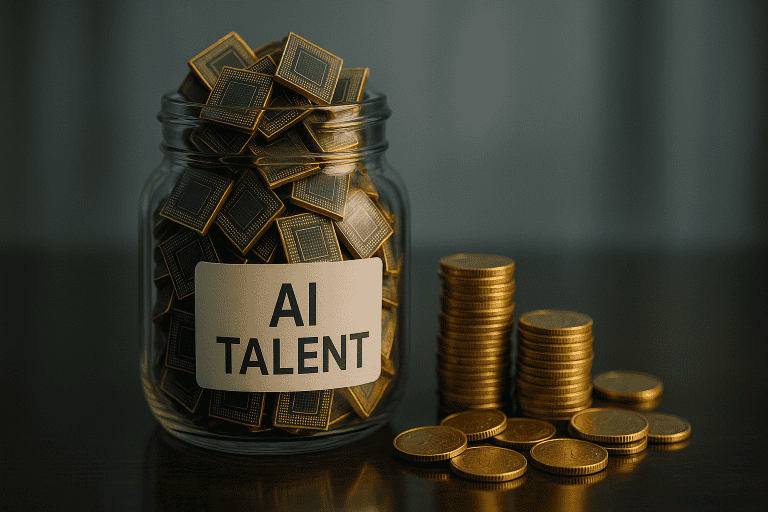
Meta’s hiring failures underscore the limitations of financial incentives in the escalating artificial intelligence talent wars, where companies vie for a select group of researchers capable of developing cutting-edge AI models.
Meta’s Desperate Search for Smart People
Mark Zuckerberg, the CEO of Meta, has been personally putting together a 50-person “superintelligence” team to work on achieving artificial general intelligence. He has been recruiting from what sources call “a brain trust of AI researchers and engineers who have met with him in recent weeks at his homes in Lake Tahoe and Palo Alto.”
To attract top talent, the social media giant offered compensation packages worth tens of millions of dollars over several years, including equity. Although Meta made these substantial offers, it was challenging for them to attract experienced professionals from other companies. The company attempted to hire Noam Brown, a top researcher at OpenAI, but the effort was unsuccessful despite offering him a substantial amount of money.
OpenAI’s Mission-Driven Strategy for Keeping Employees
Altman said that OpenAI employees turned down Meta’s offers because they “kind of look at the two paths and say, ‘All right, OpenAI’s got a really good shot, a much better shot at actually delivering on superintelligence.'” He said that Meta’s approach was wrong because it focused too much on “upfront guaranteed comp” instead of “the work and the mission.”
OpenAI already pays its employees well to keep them. Top OpenAI researchers often earn more than $10 million a year, which means the company compensates elite AI workers at a comparable rate to other companies.
When Ilya Sutskever, the former chief scientist, started his new company, OpenAI offered researchers who were thinking about joining him $2 million in retention bonuses and $20 million or more in equity increases.
Meta’s Plan for Buying Other Companies
Meta moved to corporate-level acquisitions because it couldn’t find individual talent. The company made a $14.3 billion investment for a 49% stake in Scale AI, which means the startup is now valued at $29 billion.
In a memo, Scale AI CEO Alexandr Wang confirmed his departure, saying, “Opportunities of this size often come at a cost,” and “that cost is my departure.”. According to Meta’s official statement, Wang will “join Meta to work on our superintelligence efforts.”
This acquisition is Meta’s second-largest deal after the $19 billion purchase of WhatsApp. It indicates that the company is willing to invest a significant amount of money to acquire AI capabilities.
The talent war is getting worse across the board.
Since the launch of ChatGPT in late 2022, the race for AI talent has reached the level of professional athletes. Google DeepMind has offered top researchers compensation packages worth $20 million per year, with shorter vesting periods.
These high pay levels are due to the lack of qualified workers. Databricks’ VP of AI says that there are only fewer than 1,000 researchers capable of building frontier AI models.
The number of top AI researchers is said to be “between a few dozen and a thousand people,” and they have become “the cornerstone of competitive advantage” in the AI race.
The Fight for AI Dominance
Meta’s failed attempts to hire people from OpenAI are part of a larger battle among tech giants to secure the talent they need to excel in AI. Meta can offer unprecedented financial packages, but OpenAI’s success in keeping employees shows that technical mission alignment and the perceived likelihood of breakthrough success are just as crucial as pay.
The competition isn’t slowing down. As businesses rush to develop artificial general intelligence, the small number of skilled researchers becomes increasingly valuable. Every time you successfully hire or keep someone, you have a chance to gain a competitive edge that could be worth billions of dollars in market value.
Meta is shifting its approach from hiring individuals one at a time to acquiring companies, as seen in the Scale AI deal. Companies will buy whole teams and companies instead of competing for individual talent. This trend could alter the way the AI industry operates, placing the best talent and skills within the largest tech companies.
The news about Meta’s $100 million offer gives us a rare glimpse into how far companies will go to find AI talent. They also show that money alone can’t guarantee that you’ll be able to hire the researchers who will shape the future of AI.
Key Takeaways:
- Meta attempted to hire OpenAI employees by offering them $100 million signing bonuses and even larger annual pay packages, but they were unable to secure any key talent to join them.
- In a June 2025 podcast, OpenAI CEO Sam Altman discussed how Meta had trouble hiring people. He said that his company’s focus on its mission and technical prospects helped keep good employees.
- Mark Zuckerberg, the CEO of Meta, is assembling a 50-person superintelligence team himself, and he is offering researchers annual pay packages worth tens of millions of dollars.
- The race for AI talent is now as fierce as it is for professional athletes. There are fewer than 1,000 researchers worldwide who can build cutting-edge AI models.
- Meta’s $14.3 billion investment in Scale AI marks a shift from hiring people one at a time to acquiring companies as businesses seek to find AI talent.